WACV 2027

StablePrivacy

Zero-Shot Full-Body Video Anonymization Using Diffusion Models for Downstream Data Utility

1University of Edinburgh 2Toyota Motor Europe

Hover or drag to move the slider. Left: original video. Right: StablePrivacy. The person gets a new identity, while pose, motion and background are kept. Clips from YouTube-VIS 2019, UCF101 and MARS.

Full body, not just faces

Replaces identity cues across the whole person (face, hair, clothing details), not only the face.

Temporally consistent

A memory bank inside the diffusion UNet keeps the new identity stable from frame to frame.

Zero-shot, across tasks

One model with no training on any target dataset. The same anonymized videos still train accurate models for three different downstream tasks:

Action recognitionVideo instance segmentationPerson re-ID

Abstract

Existing privacy research mainly targets facial anonymization in images, overlooking identifying cues beyond the face (e.g., clothing and hair) or the challenges of video data. We propose StablePrivacy, a diffusion-based framework for full-body video anonymization that improves the privacy–utility trade-off. Built on Stable Diffusion, our method operates in a zero-shot manner without dataset-specific training. The framework preserves pose and scene context via ControlNet conditioning and latent-space inpainting, while a memory bank enforces temporal consistency across frames. We further introduce an injection module that retains task-relevant structure while removing identity cues. Experiments on video instance segmentation, action recognition, and person re-identification show that StablePrivacy attains a stronger privacy–utility trade-off than existing full-body anonymization methods, with competitive downstream performance across tasks and the clearest gains on person re-identification.

Method

How StablePrivacy works

Each frame is encoded with the Stable Diffusion VAE and split into two branches. A heavily noised generation branch creates a new person (privacy); a lightly noised injection branch carries the structure and visual domain of the input (utility). Pose and background are kept, and frames are generated in order with a memory of the previous frame.
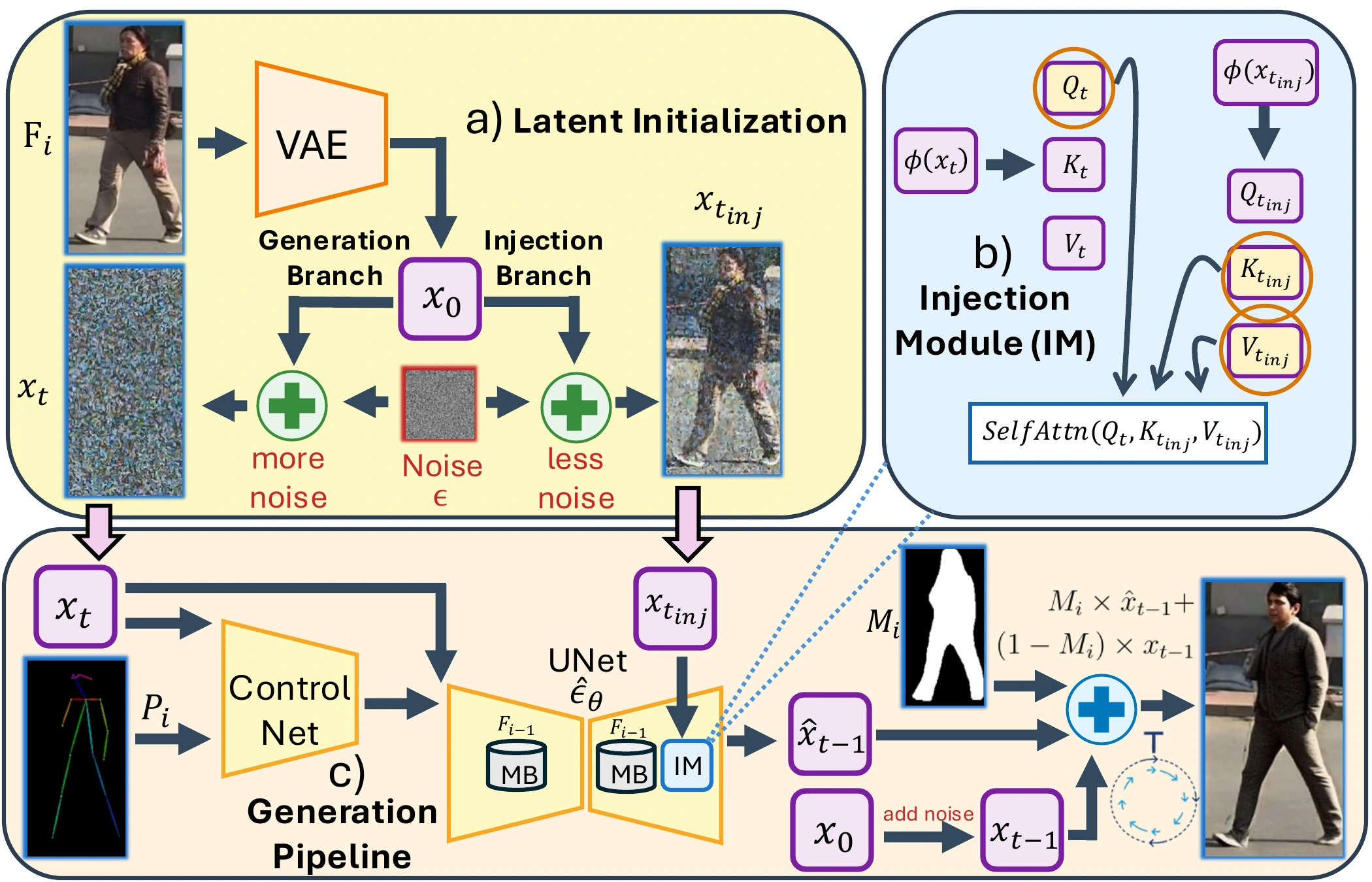
StablePrivacy pipeline: latent initialization with a generation and an injection branch, the injection module inside self-attention, and the generation pipeline with ControlNet, memory bank and latent inpainting.
Pipeline. (a) Latent initialization with more noise for the generation branch and less for the injection branch. (b) The Injection Module feeds keys and values of the injection latent into self-attention of the generation. (c) Generation with ControlNet pose conditioning, a memory bank (MB) and latent-space inpainting.
IM

Injection Module

Keys and values from the lightly noised input (σi = 0.3) replace those of the generation in the UNet decoder’s 16×16 self-attention block. The new person keeps the input’s structure and visual domain, which downstream models need.

MB

Memory bank

Keys, values and attention outputs of the previous frame are cached and concatenated in every self-attention layer, so each frame attends to the last one. This removes flicker and identity drift.

LI

Latent inpainting

At every denoising step the background latent is copied from the input at the same noise level, using the person mask. The background stays intact, with no cut-and-paste seams.

CN

ControlNet pose

Pose conditioning makes the new person follow the original motion exactly, which keeps the action and the tracklet usable for training.

Evaluation protocol: train on anonymized, test on real

We anonymize only the training split, train a standard downstream model on it, and test that model on the original, untouched test split. Utility therefore measures how well anonymized videos can replace real data when a training set is released.

Privacy is measured by running a pre-trained re-identification model on anonymized queries: the lower its mAP, the harder it is to match the anonymized person to the real one.
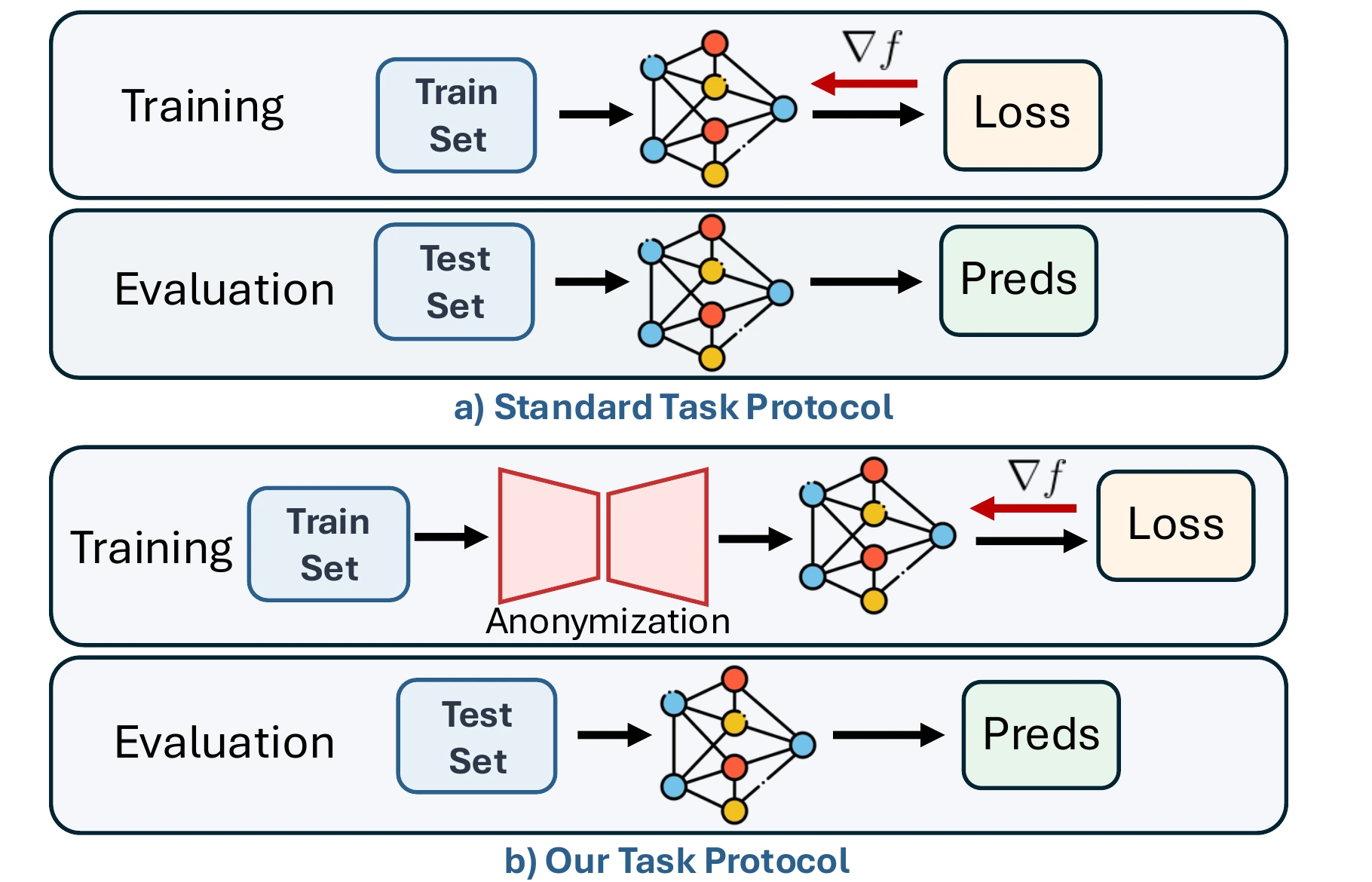
Standard protocol versus ours: in ours the training set is anonymized before training, while evaluation uses the original test set.

Qualitative results

Original vs. anonymized videos

Every clip below is split by a moving slider: original on the left, StablePrivacy on the right. Hover over a clip to control the slider yourself.

Comparisons

Against existing baselines

All methods use the same person masks and poses. Pick an example; videos play in sync.

Quantitative results

A better privacy–utility trade-off

Utility gain from the Injection Module
+9.5 mAP
at a similar privacy level, MSMT17 re-ID
Re-ID utility on MSMT17
40.5 mAP
vs. 11.7 for DeepPrivacy2 and 22.6 for the SD baseline
Rank-1 gap to real data on MARS
3.0 pts
91.8 trained on ours vs. 94.8 on original

Privacy vs. utility on MSMT17

Privacy: mAP of a pre-trained re-ID model on anonymized queries (lower is better). Utility: mAP of a re-ID model trained on anonymized data and tested on real data (higher is better). The best place is the top-left corner.

The orange line removes our Injection Module and only varies the noise σ: it gains utility only by leaking more identity. StablePrivacy lies above it, with +9.5 mAP utility at a similar privacy level, so the gain does not come from noise tuning. Versus RAD: RAD falls close to this w/o IM line, so its trade-off is what noise tuning alone reaches. It also anonymizes each frame separately and pastes the result onto the background in pixel space, which brings flicker, identity changes between frames and visible seams. StablePrivacy also beats AnimateDiff on both axes and keeps 1.8× the utility of the SD Baseline and 3.5× that of DeepPrivacy2.

Show data table

Person re-ID on MSMT17

TransReID trained on anonymized data, tested on real data. mAP (%), higher is better.

Video person re-ID on MARS

VID-Trans-ReID trained on anonymized videos, tested on real videos. Higher is better.

mAP (%)

Rank-1 (%)

Training on StablePrivacy videos keeps rank-1 accuracy within 3.0 points of training on real videos; DeepPrivacy2 is 11.3 points behind.

Action recognition on UCF101

C3D top-1 accuracy (%) on the real test set, with backgrounds removed so the score depends on the person.

MethodFG onlySubset (FG)
Original64.1340.49
StablePrivacy57.9735.74
DeepPrivacy255.6733.10
SD Baseline–32.75
StreamV2V–22.89

Subset: a representative 15% of UCF101 (2,052 videos) used to compare all baselines.

Temporal consistency

Average content distance (ACD) between frames on YouTube-VIS 2019. Lower is smoother.

The memory bank lowers ACD from 0.672 to 0.574. Stable Animator and StreamV2V are smoother but regenerate the whole frame and lose almost all utility (0.5 mAP on MSMT17).

Ablation on MSMT17

Re-ID utility (mAP) when one component is removed.

VariantmAP
Full StablePrivacy40.5
without Injection Module21.1
without memory bank34.6
without ControlNet30.9
without latent inpainting41.6

Pixel-space inpainting scores slightly higher here but leaves visible boundary artifacts around the person.

Limitations

There is no explicit control over the generated identity or clothing: what is kept and what is replaced depends on the noise levels of the two branches, and the Injection Module carries over coarse appearance such as clothing type and colour. Because pose is preserved, gait remains a privacy channel: StablePrivacy halves rank-1 gait retrieval compared with the original data and leaks less than DeepPrivacy2, but does not remove it.

BibTeX

@inproceedings{bharadwaj2027stableprivacy,
  title     = {StablePrivacy: Zero-Shot Full-Body Video Anonymization Using
               Diffusion Models for Downstream Data Utility},
  author    = {Bharadwaj, Rohit and Danier, Duolikun and Ye, Zhenzhang and
               Sundram, Jugesh and Sevilla-Lara, Laura and Bilen, Hakan},
  booktitle = {Proceedings of the IEEE/CVF Winter Conference on
               Applications of Computer Vision (WACV)},
  year      = {2027}
}